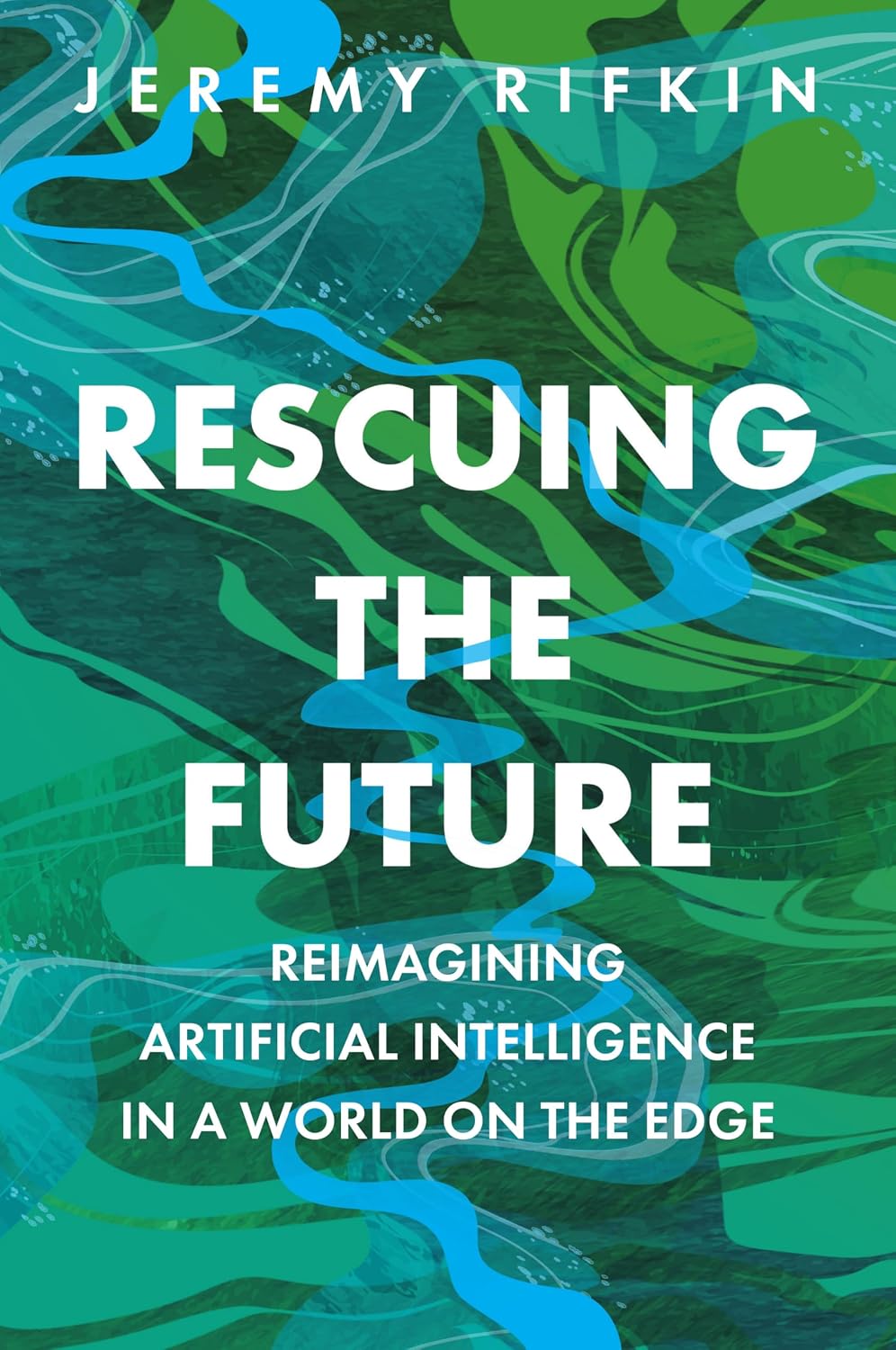
Jeremy Rifkin, one of the World’s Leading Public Intellectuals, Argues in his New Book ‘Rescuing the Future’ that the People’s AI is on a Deep Existential Curve and Likely to Surpass the Corporate AI Giants Well Before Mid-Century in Bioregions Around the World

A dramatic alternative to big-tech AI and cloud computing overseen by a handful of global companies in a geopolitical world is quietly trending in bioregions on every continent. The People’s AI is driven by millions of small- and medium-sized enterprises and cooperatives using fog computing and the Internet of Things (IoT) nestled in bioregions and stewarded in the form of commons governance while connected via open-source glocal platforms with counterparts around the world. The People’s AI is on a steep existential curve and will be omnipresent in communities everywhere and connected glocally in an integrated and adaptive planetary milieu while Big AI will provide technical niche services in coming decades. This dramatic rethinking of AI is taking us from a dying Age of Progress to an emerging Age of Resilience, hopefully in time to save our planetary home in the 21st Century.
At stake is a great transformation on the ontological edge. Once the mysterious language of philosophers, ontology has suddenly leaped onto the public stage in the AI era, becoming the language of corporate titans, heads of state, and distinguished public intellectuals, but surprisingly also emerging in a very different form below the radar screen in civil society.
Ontology is the philosophical term that describes the “nature of being” and has long been hidden away from the public domain although it shapes the very way we perceive existence around us. The ontological dialectic pits two diametrically opposing paradigms which philosophers call substance ontology vs. process ontology.
Substance ontology posits that existence is spatially oriented, atemporal, and made up of inert substances and things – to wit, extractive resources – while process ontology counter-argues that existence is temporal in nature and made up of processes, patterns, fluxes, and flows – to wit, animated life sources – brimming with agency, interacting at every moment with other phenomena, and continually changing the reality around us. The great existential question at this critical juncture in history is do we live in an atemporal extractive world or a temporal adaptive world?
AI Substance ontology has taken our species and our fellow creatures to the brink of a mass extinction in the lifetime of today’s babies while AI process ontology calls for a reflourishing of life on a neoanimist planet. The unfolding of an AI ontology face-off will likely decide whether life has a future on our tiny abode in the universe.
Beginning in the first decade of the 21st century and accelerating in the second decade, a handful of AI companies morphed from niche projects to global corporate giants, spurring a deep rethinking of a long-hidden ontological worldview and the clash between substance ontology vs. process ontology with the former prevailing. Big-tech AI is now being challenged in the throes of an AI process ontology counterforce with the Gen-Z generation coming into the workforce and shaking up how society conceives of commerce, governance, civil society, and academia.
This emerging generation sees itself as an endangered species and its fellow creatures as its extended family and views existence as interactive, embedded, temporal, and communal and life’s mission as stewardship rather than ownership. Gen Zs pay homage to AI collective intelligence of all life on the planet and champions process ontology. For this generation, biophilia supersedes biophobia.
Rescuing the Future: Reimagining Artificial Intelligence in a World on the Edge is the first work of its kind to address this key turning point from an AI substance ontology future to an AI process ontology future.
Jeremy Rifkin is the bestselling author of twenty-five books translated into over thirty-five languages. He is a principal architect of the European Union’s and China’s economic plans for transitioning into a Third Industrial Revolution and he served as an economic advisor to Senate Majority Leader Charles Schumer on the U.S. infrastructure plan. He is listed among the top ten most influential economic thinkers in The Huffington Post’s global survey of “The World’s Most Influential Voices.”