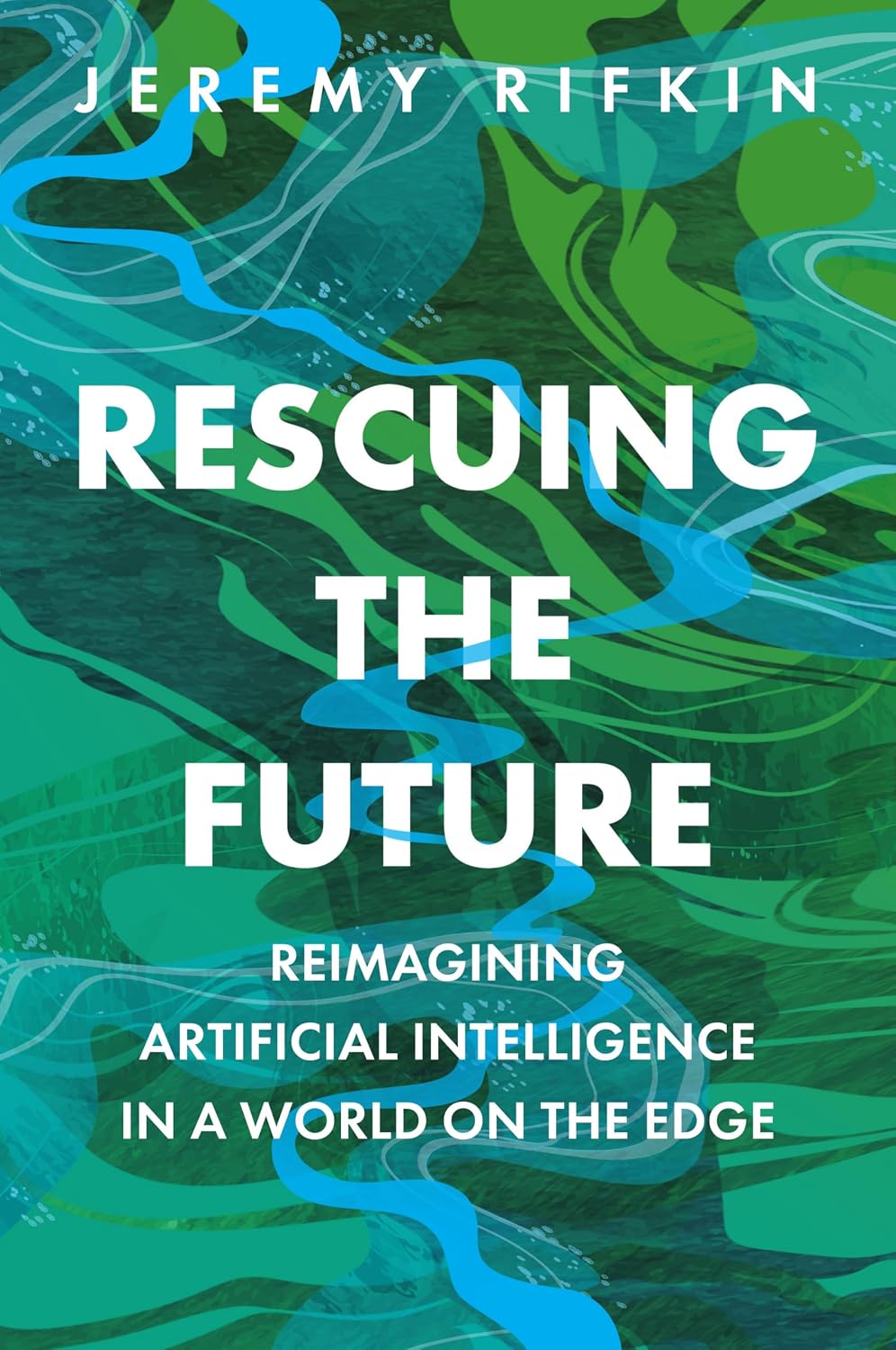
Jeremy Rifkin, one of the World’s Leading Public Intellectuals, Argues in his New Book ‘Rescuing the Future’ that the People’s AI is on a Deep Existential Curve and Likely to Surpass the Corporate AI Giants by 2050 in Bioregions Around the World
Jeremy Rifkin’s Third Industrial Revolution People’s AI Infrastructure Deployments – from Policy to Practice – Taken up by Europe, China and the US
The first quarter of the twenty-first century has been marked by mounting instability in the institutions that defined the industrial age. Fossil-fuel civilization, centralized governance systems, vertically integrated corporate structures, and linear economic models have encountered intensifying pressure from climate disruption, digital decentralization, geopolitical fragmentation, and the accelerating rise of artificial intelligence. Within this turbulent transition, the work of Jeremy Rifkin and TIR Consulting LLC has occupied a singular place in the international conversation on infrastructure, economics, and civilization. Over more than two decades, Rifkin and his team advanced a conceptual and operational framework known as the Third Industrial Revolution (TIR), an approach that attempted to integrate renewable energy, digital communications, automated logistics, distributed manufacturing, and ecological governance into a coherent new economic paradigm.
What distinguished the TIR framework from many conventional development strategies was not merely its emphasis on green energy or digital connectivity. Its deeper significance lay in its philosophical orientation. Beneath its infrastructure planning was an implicit transition from what philosophers traditionally describe as “substance ontology” toward a more relational and ecological “process ontology.” Substance ontology assumes that reality is composed primarily of fixed entities competing for control, accumulation, and dominance. Process ontology, by contrast, understands reality as dynamic networks of relationships, flows, interdependence, and continuous transformation. Rifkin’s contribution to contemporary economic thought rested in large measure on his effort to operationalize this transition through actual infrastructure deployments across Europe, China, and North America.
Rifkin’s advisory work with four successive Presidents of the European Commission—Romano Prodi, José Manuel Barroso, Jean-Claude Juncker, and Ursula von der Leyen—illustrated how process-oriented infrastructure thinking increasingly entered the institutional center of European policymaking. In parallel, TIR Consulting worked with regions including Hauts-de-France, Luxembourg, the metropolitan corridor between Rotterdam and The Hague, the city of San Antonio, and leadership circles in the People’s Republic of China. Rifkin’s ideas also intersected with debates surrounding the Biden administration’s Build Back Better agenda and discussions with Chuck Schumer regarding infrastructure modernization and economic resilience.
At the core of the TIR model was the proposition that every major economic era emerges from the convergence of new communication systems and new energy regimes. The First Industrial Revolution combined coal, steam power, and print culture. The Second Industrial Revolution fused oil, centralized electricity, and mass telecommunications. Rifkin argued that the Third Industrial Revolution would integrate digital internet technologies with distributed renewable energy systems, transforming buildings, transportation networks, logistics systems, and governance structures into intelligent, collaborative platforms. In this sense, the TIR framework resembled a civilizational operating system rather than a conventional economic development strategy.
The philosophical implications of this framework became especially important with the rise of artificial intelligence. Contemporary AI systems have largely emerged within what Rifkin characterized as a substance ontology paradigm: centralized cloud infrastructures, vertically integrated corporate monopolies, proprietary data silos, and geopolitical competition for computational supremacy. This dominant model conceives intelligence as a resource to be accumulated and controlled. By contrast, Rifkin’s evolving process ontology perspective envisioned distributed intelligence operating across networks of cooperation, ecological adaptation, and lateral scaling. The difference between these paradigms may ultimately determine whether AI intensifies industrial-age extractive systems or contributes to a more resilient civilization.
Rifkin’s early engagement with the European Union helped institutionalize this broader transformation. During the presidency of Romano Prodi, the European Commission increasingly explored long-range sustainability planning and regional integration strategies that moved beyond purely national frameworks. Rifkin’s consultations emphasized the need to modernize Europe’s infrastructure around decentralized renewable energy and digital coordination systems. The conceptual ambition was significant: Europe would not merely adopt greener technologies but reorganize its economic metabolism around collaborative networks capable of reducing carbon intensity while increasing social resilience.
Under José Manuel Barroso, these ideas gained greater operational traction. The European Union’s climate initiatives, smart grid discussions, and digital integration efforts increasingly reflected themes central to the TIR framework. Rifkin’s proposals aligned with Europe’s emerging identity as a regulatory and sustainability-oriented superpower. Rather than competing directly with the United States or China through industrial gigantism alone, Europe began positioning itself as a laboratory for ecological modernization. This approach resonated strongly with process ontology because it emphasized systems integration over isolated technological dominance.
The presidency of Jean-Claude Juncker further deepened these developments. The Juncker Commission confronted rising populism, Brexit tensions, migration crises, and growing geopolitical instability. In response, infrastructure planning increasingly became linked to resilience rather than mere growth. TIR Consulting advocated integrated regional systems in which renewable energy production, digital communications, transportation electrification, and local entrepreneurship formed mutually reinforcing ecosystems. The emphasis shifted from maximizing industrial output toward enhancing adaptive capacity across interconnected social systems.
With Ursula von der Leyen, many elements of Rifkin’s long-term vision entered mainstream European strategy through initiatives associated with the European Green Deal and broader digital transformation agendas. Although these policies emerged from many contributors and institutions, Rifkin’s influence remained visible in the emphasis on decarbonization, smart infrastructure, hydrogen economies, distributed energy systems, and coordinated continental planning. The underlying logic reflected process ontology: the economy was increasingly understood not as a collection of isolated industries but as a living network of relationships requiring synchronization across ecological, technological, and social dimensions.
The TIR approach was not confined to Brussels. One of the most ambitious regional applications emerged in Hauts-de-France, where local authorities collaborated with TIR Consulting to develop a long-term transformation strategy. The region sought to reinvent itself after decades of industrial decline associated with coal mining and heavy manufacturing. Rifkin’s framework proposed turning this former industrial heartland into a node within a distributed renewable-energy economy. Buildings would become micro-power plants. Transportation systems would become electrified and digitally coordinated. Small and medium-sized enterprises would participate in interconnected regional ecosystems rather than remain dependent upon centralized industrial hierarchies.
This regional strategy represented a direct challenge to substance ontology economics. Traditional industrial planning assumes that wealth emerges primarily through concentrated ownership, centralized production, and economies of scale. The TIR model instead proposed that value increasingly emerges through network participation, interoperability, and collaborative efficiency. Economic power would become more distributed, with millions of smaller actors connected through intelligent infrastructure systems. In many respects, this anticipated later debates surrounding distributed AI, edge computing, and decentralized digital ecosystems.
Similar principles appeared in Luxembourg’s engagement with TIR Consulting. Luxembourg, despite its small size, sought to position itself strategically within the evolving digital and green economy. Rifkin’s team encouraged investments in smart mobility, renewable integration, circular economic systems, and digital infrastructure capable of linking multiple sectors into coherent adaptive networks. Here again, the emphasis was not solely technological. It was ontological. The infrastructure itself embodied a new understanding of economic life as relational, dynamic, and ecological.
The Netherlands provided another major testing ground for these ideas, particularly in the corridor encompassing Rotterdam, The Hague, and surrounding municipalities. The collaboration involving the thirty-three cities stretching between Rotterdam and The Hague reflected one of the most sophisticated regional planning initiatives associated with the Third Industrial Revolution framework. The region already possessed advanced logistics systems, port infrastructure, and digital connectivity. TIR Consulting proposed integrating these assets into a broader resilience architecture linking renewable energy systems, intelligent transportation, urban planning, and data-sharing platforms.
The significance of this regional initiative extended beyond Europe. It demonstrated how metropolitan regions might evolve into networked ecological platforms rather than simply concentrations of industrial capital. Such thinking aligned increasingly with emerging process-oriented understandings in systems theory, ecology, and complexity science. Rather than imposing rigid top-down control, successful systems would facilitate adaptive coordination among diverse participants. In this sense, Rifkin’s infrastructure philosophy anticipated many later conversations about distributed AI governance.
The city of San Antonio also became part of this broader experimentation. Municipal leaders explored how the TIR framework could help modernize urban infrastructure while addressing climate resilience, energy transition, and economic inclusion. San Antonio’s interest illustrated the growing appeal of process-oriented infrastructure planning within North America, particularly as cities confronted aging industrial systems and increasing climate vulnerabilities. The emphasis on integrating energy, transportation, buildings, and digital systems reflected the same underlying philosophical shift visible in Europe.
Rifkin’s relationship with China was more complex and historically significant. China’s extraordinary industrial expansion during the late twentieth and early twenty-first centuries represented perhaps the most powerful expression of substance ontology economics in modern history. Massive centralized infrastructure projects, vertically integrated industrial systems, and state-directed manufacturing growth transformed China into the world’s industrial powerhouse. Yet Chinese leadership also recognized the environmental and social limits of this model. Pollution, resource depletion, regional inequality, and ecological instability generated growing pressure for structural transformation.
Rifkin’s advisory engagements with Chinese institutions introduced elements of the Third Industrial Revolution framework into discussions surrounding sustainability, urbanization, and digital infrastructure. Chinese policymakers became increasingly interested in smart cities, renewable energy systems, electrified transportation, and internet-enabled infrastructure coordination. China’s rapid expansion in solar manufacturing, electric vehicles, high-speed rail, and digital platforms reflected, at least partially, a recognition that future competitiveness would depend upon integrated intelligent systems rather than traditional industrial extraction alone.
Nevertheless, China also embodied tensions between substance ontology and process ontology. On one hand, the country aggressively pursued distributed renewable infrastructure and advanced digital systems. On the other hand, it maintained highly centralized political and technological governance structures. Thus China became a hybrid case: simultaneously pioneering networked infrastructure while preserving strong hierarchical control mechanisms. This duality mirrored broader global tensions surrounding AI development itself.
The emergence of artificial intelligence intensified the relevance of Rifkin’s process ontology perspective. Most dominant AI architectures today remain embedded within centralized cloud infrastructures controlled by a handful of global corporations and nation-states. These systems depend upon enormous data centers, massive computational concentration, and vertically integrated ownership models. Such arrangements reproduce the logic of Second Industrial Revolution capitalism even while deploying advanced digital technologies.
Rifkin’s broader philosophical trajectory, however, pointed toward a different possibility. In a process ontology framework, AI would not merely optimize centralized industrial systems. Instead, intelligence would become distributed across collaborative networks involving households, local governments, cooperatives, small enterprises, regional infrastructures, and ecological monitoring systems. AI could help coordinate decentralized renewable grids, optimize local resource flows, facilitate circular manufacturing, and strengthen community resilience. Rather than functioning primarily as instruments of corporate surveillance and geopolitical competition, intelligent systems could become relational infrastructures supporting ecological adaptation.
This perspective increasingly influenced policy discussions in the United States during debates surrounding infrastructure modernization and climate investment. Senate Majority Leader Chuck Schumer became associated with legislative efforts aimed at revitalizing American infrastructure, semiconductor manufacturing, clean energy investment, and technological competitiveness. While the Build Back Better agenda emerged from many political forces, it reflected several themes compatible with Rifkin’s long-standing arguments: large-scale infrastructure transformation, renewable energy expansion, digital modernization, and resilience-oriented economic planning.
The Build Back Better discussions demonstrated how process ontology concepts were gradually entering mainstream governance discourse, even when not explicitly identified as such. Policymakers increasingly recognized that infrastructure systems could no longer be understood independently. Energy grids, supply chains, communications systems, transportation networks, ecological systems, and digital platforms had become deeply interdependent. Crises such as the COVID-19 pandemic, climate disasters, and geopolitical disruptions exposed the fragility of purely linear industrial models.
Rifkin’s intellectual contribution lay partly in recognizing this transformation earlier than many policymakers. His writings repeatedly emphasized empathy, interdependence, distributed collaboration, and ecological embeddedness as defining characteristics of the emerging era. Critics sometimes dismissed his work as overly idealistic or technologically deterministic. Yet many of the structural trends he identified—decentralized energy, internet-based coordination, platform economies, electrified transportation, and sustainability-driven infrastructure planning—became central features of twenty-first-century policy debates.
At the same time, the transition from substance ontology to process ontology remains incomplete and contested. Large technology corporations continue consolidating unprecedented power over data, AI systems, and digital infrastructure. Geopolitical competition between the United States and China increasingly revolves around control of semiconductors, cloud computing, rare earth minerals, and AI dominance. Militarization of digital technologies threatens to reinforce hierarchical and extractive structures rather than dissolve them.
This contradiction defines the current historical moment. The technological architecture necessary for a more distributed and collaborative civilization now exists, yet institutional power remains heavily concentrated. Rifkin’s Third Industrial Revolution framework can therefore be interpreted not simply as an economic model but as a civilizational struggle over ontology itself. Will society continue organizing around assumptions of isolated competition, centralized accumulation, and extractive growth? Or will emerging technologies support relational systems emphasizing resilience, cooperation, and ecological integration?
The importance of this question becomes even greater as artificial intelligence evolves toward greater autonomy and systemic influence. AI trained within substance ontology assumptions may intensify surveillance capitalism, labor displacement, and geopolitical rivalry. AI developed within process ontology frameworks could instead enhance distributed coordination, ecological stewardship, and collaborative problem-solving. The distinction is not merely technical. It concerns the underlying philosophical assumptions embedded within infrastructure systems.
Jeremy Rifkin and TIR Consulting LLC helped place these questions onto the global policy agenda long before they became widely recognized. Through collaborations with European Commission presidents, regional governments, municipalities, and international institutions, they attempted to translate philosophical transformation into concrete infrastructure planning. Their projects across Europe, North America, and China represented experimental efforts to build institutional architectures appropriate for a networked ecological age.
Whether these efforts ultimately succeed remains uncertain. The transition now underway involves enormous political, economic, and cultural conflicts. Fossil-fuel industries, centralized corporate structures, and geopolitical rivalries continue exerting powerful influence. Yet the growing convergence of renewable energy, digital communication, intelligent infrastructure, and ecological necessity increasingly validates the central insight underlying the Third Industrial Revolution framework: the industrial-age model of isolated, centralized control is becoming structurally unsustainable.
Conclusion
The historical significance of Jeremy Rifkin and TIR Consulting LLC lies not only in specific policy recommendations or infrastructure projects but in their broader attempt to redefine the conceptual foundations of economic life during a period of civilizational transition. By advising four Presidents of the European Commission, engaging regions such as Hauts-de-France and Luxembourg, participating in metropolitan planning initiatives from Rotterdam to The Hague, consulting with San Antonio, interacting with Chinese leadership circles, and influencing discussions surrounding Build Back Better and Senate Majority Leader Chuck Schumer’s infrastructure agenda, Rifkin helped internationalize a new developmental paradigm.
At the center of this paradigm was a shift from substance ontology toward process ontology. The industrial systems of the nineteenth and twentieth centuries were built upon assumptions of centralized ownership, extractive growth, and competitive accumulation. The emerging era increasingly requires relational intelligence, distributed coordination, ecological integration, and adaptive resilience. Rifkin’s Third Industrial Revolution framework sought to operationalize these principles through actual infrastructure systems linking renewable energy, digital communication, smart mobility, and collaborative economic networks.
The rise of artificial intelligence has made this ontological transition even more consequential. AI can either reinforce the centralized logic of industrial capitalism or facilitate more distributed and ecological forms of organization. Rifkin’s work suggested that the future of civilization may depend less upon technological capability itself than upon the philosophical assumptions embedded within technological systems.
In this sense, the Third Industrial Revolution was never simply about energy transition or digital modernization. It represented an effort to redefine how societies understand power, value, intelligence, and human interdependence in an increasingly connected world. The enduring relevance of Rifkin’s work lies precisely in this deeper insight: infrastructure is never merely technical. It is always ontological, expressing a civilization’s understanding of reality and its place within the living processes of the Earth.
Bibliography
The Third Industrial Revolution. New York: Palgrave Macmillan, 2011.
The Green New Deal. New York: St. Martin’s Press, 2019.
The Zero Marginal Cost Society. New York: Palgrave Macmillan, 2014.
The Empathic Civilization. New York: TarcherPerigee, 2009.
European Commission. “European Green Deal Policy Initiatives.” Brussels, various publications, 2019–2025.
TIR Consulting Group. Regional development strategy reports for Europe, China, and North America, various publications.
European Union. Energy Union and Digital Europe policy documents, Brussels, various publications.
China. National sustainability and smart infrastructure planning documents, Beijing, various publications.