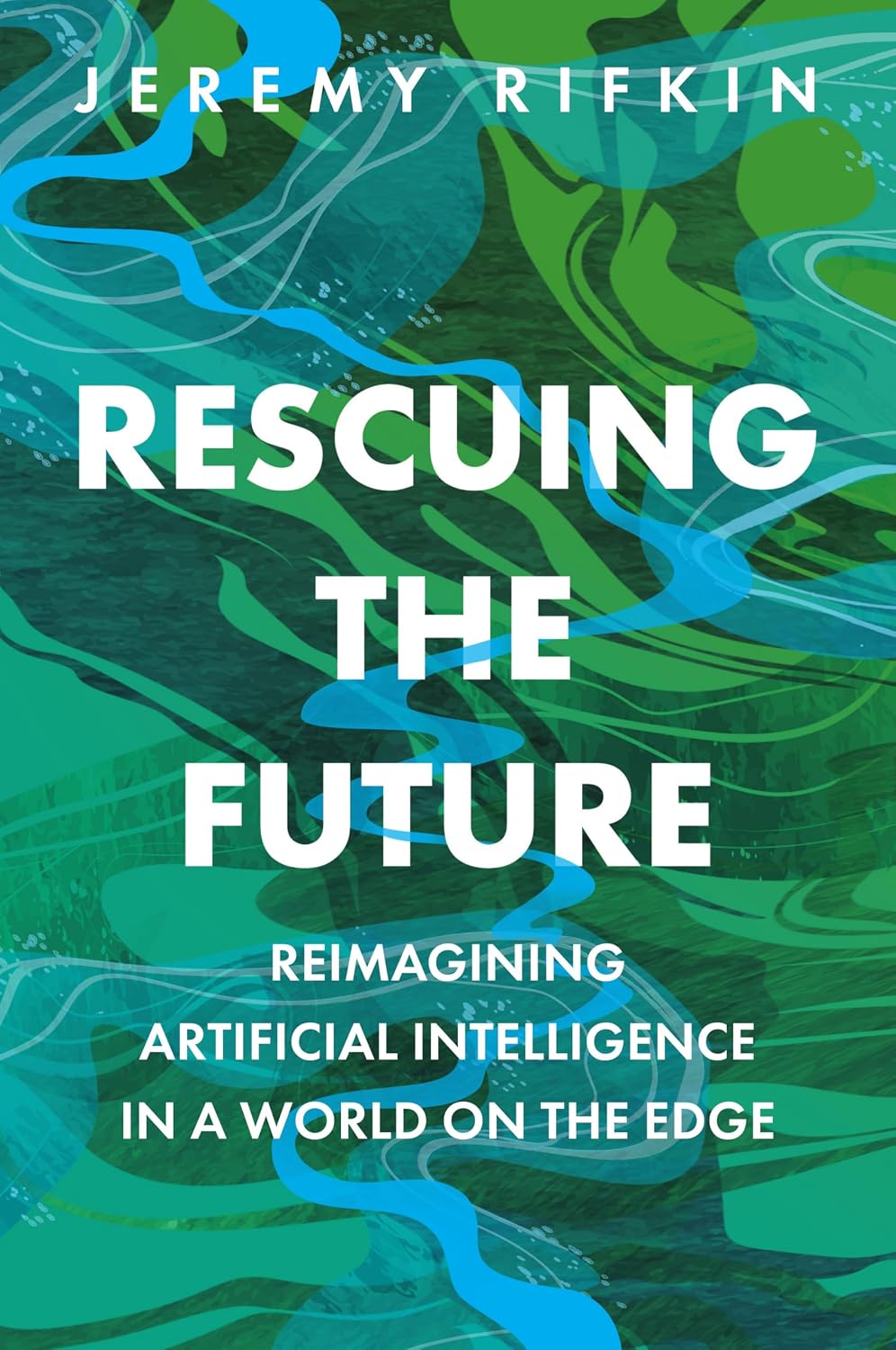
Jeremy Rifkin, one of the World’s Leading Public Intellectuals, Argues in his New Book ‘Rescuing the Future’ that the People’s AI is on a Deep Existential Curve and Likely to Surpass the Corporate AI Giants by 2050 in Bioregions Around the World
| A living planet does not wait for a computer to describe it before continuing to become. Water moves through organisms, soils, clouds, and oceans; cells coordinate activity; animals navigate; human communities interpret changing conditions. These relationships make civilization possible, including the computers through which civilization now studies them. Jeremy Rifkin’s challenge to Big AI begins with this reversal of perspective. Intelligence is already present in diverse forms throughout living existence. The question is whether artificial intelligence will help people participate responsibly in that existence or encourage the belief that its owners can finally stand above it. In the published presentation of Rescuing the Future: Reimagining Artificial Intelligence in a World on the Edge, Rifkin contrasts concentrated corporate AI with a distributed People’s AI linked to ecosystems and bioregional commons. He describes this choice through substance ontology and process ontology: treating existence principally as appropriable things, or understanding it through relationships, patterns, and becoming. This essay draws on that documented framing and his earlier work, while identifying its own extensions and conditional scenarios. The central disagreement concerns the purpose and governance of intelligence, rather than simply which machines perform best. The Office of Jeremy Rifkin Rifkin’s recent argument belongs to a longer inquiry into the organization of economic life. The Zero Marginal Cost Society examines how networked infrastructure can support collaborative production and sharing alongside markets. Its relevance to AI is that the distribution of benefits cannot be inferred from the sophistication of technology. A network may enable many people to contribute while allowing a few firms to control access. The decisive distinction is between participation in shaping shared capacities and dependence on services whose purposes, prices, and conditions are determined elsewhere. The Office of Jeremy Rifkin The Age of Resilience develops the ecological implications of that distinction, emphasizing adaptivity and an ecological understanding of selfhood over the relentless pursuit of efficiency. Planet Aqua places the hydrosphere at the center of human dependence and urges societies to adapt to water’s dynamics rather than imagine unlimited dominion over them. These arguments provide an evaluative standard for AI: whether it strengthens the conditions of continuing life. Higher computational performance can contribute to that purpose, but it cannot substitute for it. Efficiency remains valuable only in relation to what is being made efficient. The Office of Jeremy Rifkin “Collective intelligence of all life” must nevertheless be understood carefully. It need not mean that the biosphere has one conscious mind, a single intention, or an intelligence quotient. It can describe interacting capacities distributed among organisms and across biological scales. Patrick McMillen and Michael Levin explore collective intelligence as a framework connecting cellular, organismal, and group-level problem-solving. Their work broadens inquiry beyond the solitary human thinker. It does not establish a universal ranking in which a forest, a person, and a computer can be assigned directly comparable scores. Communications Biology Human intelligence itself depends on collective relationships. Languages, scientific methods, caregiving, education, and institutions make individual achievements possible. Anita Woolley and colleagues’ research on small groups found evidence of a collective intelligence factor associated with social sensitivity and more equal conversational participation. Its implications should not be inflated into a universal law, but it demonstrates why assembling highly capable individuals is insufficient to explain group performance. How participants relate matters. A society’s intelligence can therefore deteriorate if technological convenience undermines the relationships through which people learn, deliberate, and correct one another. ofew.berkeley.edu Life’s collective capacities are neither infallible nor harmonious. Organisms misjudge conditions, species compete, and ecosystems can undergo destructive transitions. Their significance lies in ongoing material participation. A living being must maintain relationships that permit its persistence; it cannot simply replace an unfavorable description with a more persuasive sentence. This distinction does not prove that artificial systems can never acquire new forms of autonomy. It establishes why representing living activity and participating as a living organism are different accomplishments, and why one cannot casually be declared the historical replacement for the other. Artificial intelligence has real capabilities that deserve recognition. AlphaFold’s advances in protein structure prediction demonstrate substantial scientific achievement. Machine learning can reveal patterns, generate hypotheses, and improve selected forms of prediction beyond previous methods. Describing these systems as mere repositories of old information misses their capacity to generalize. Yet predicting biological structures does not make a model a living organism, and outperforming people at a task does not establish superiority to the total relationships sustaining a planet. The achievement and the larger claim require different evidence. Nature The term “superintelligence” can obscure this distinction. In Nick Bostrom’s influential formulation, it refers to an intellect substantially exceeding human intellectual capacities across a broad range of fields. It does not inherently denote consciousness, ecological wisdom, or superiority to all biological life. Nor does it cease to be artificial intelligence. Public rhetoric can nevertheless turn the term into a promise of historical succession: ordinary AI becomes a preliminary stage, and the anticipated superintelligence becomes the destination against which everything else appears incomplete. That progression is a narrative, not an established planetary fact. nickbostrom.com Corporate statements supply concrete examples of this prospective language. OpenAI’s 2023 discussion of superintelligence anticipates exceptional capabilities and calls for oversight, while Meta’s 2025 announcement presents personal superintelligence as empowering individuals. Sam Altman’s “The Intelligence Age” connects anticipated advances to expanded computation, chips, and energy. These texts should be read as statements of ambition and belief, rather than independent demonstrations of the futures they describe. They also differ from one another. The industry cannot fairly be reduced to a single explicit intention to replace humanity. openai.com Dario Amodei’s “Machines of Loving Grace” makes the necessary distinction unusually clear. It imagines powerful AI accelerating improvements in health, science, and prosperity, while acknowledging uncertainty and practical limits. It also warns against corporate grandiosity and quasi-religious presentations of technology. Such qualifications matter. A rigorous criticism of Big AI should engage its strongest arguments: that powerful models could help solve difficult problems and make valuable expertise more accessible. The question is whether these benefits require the extraordinary concentration of authority that can accompany the infrastructure used to deliver them. darioamodei.com Superintelligence can function as marketing without being a consciously fabricated deception. A future of unprecedented abundance makes present investment appear indispensable. A future of unprecedented danger can make the same developers appear uniquely qualified to oversee it. Together, these narratives can elevate firms from suppliers into prospective custodians of civilization. This is an interpretation of the narrative’s institutional effects, not proof of hidden motives. Its practical consequence is that communities may be asked to accept immediate burdens in exchange for benefits whose scale, timing, and distribution remain uncertain. Planetary reality imposes a different discipline. Models select features, compress observations, and operate through assumptions. A dataset describing a river is not the river’s ongoing interaction with sediments, organisms, weather, and human decisions. More observations improve knowledge without abolishing the distinction. Sensors also provide mediated access, with particular coverage and sampling rates. AI can process live information and sometimes adapt rapidly, so it is inaccurate to dismiss every system as static. What remains unsupported is the idea that faster updating will necessarily culminate in a complete representation of unfolding existence. Thermodynamics and nonlinear dynamics reinforce this restraint. Prigogine’s work on dissipative structures situates organized activity within exchanges of matter and energy. Lorenz’s research shows why sensitive dependence on initial conditions can limit certain predictions. Neither establishes that biological organisms possess privileged foreknowledge or that machines cannot forecast useful outcomes. Together they remind us that intelligence operates within physical processes rather than escaping them. The “entropy tail,” understood here as an interpretive phrase for dissipative aftermath and continuing consequences, also belongs to computation itself: its material effects enter the world it seeks to model. pubmed.ncbi.nlm.nih.gov To ask what happens if Big AI prevails therefore requires defining “prevails.” It need not mean that a machine becomes omniscient or conscious. It could mean that a small number of companies control indispensable layers of knowledge production, administration, commerce, and infrastructure. Their systems could become the default means through which institutions perceive problems and choose responses. The relevant scenario is corporate and administrative dominance, not a scientifically demonstrated transcendence of life. This distinction makes the inquiry more urgent because much of the concentration can occur before hypothetical superintelligence is achieved. The first likely pressure under that scenario is economic dependence. Firms and public agencies that integrate deeply with particular platforms can face high costs when changing providers. In its January 2025 staff report, the U.S. Federal Trade Commission identified potential competition concerns in major cloud–AI partnerships, including access to inputs, switching costs, and information advantages. These findings identify risks, not a conclusion that every partnership is unlawful. They nevertheless show how the structure of AI provision can influence whose innovations reach users and whose alternatives remain viable. Federal Trade Commission If such dependence deepens, productivity gains may coexist with greater concentration of income and bargaining power. Small enterprises could obtain excellent tools while becoming reliant on changing subscription terms, proprietary interfaces, and distant technical decisions. Workers might become more productive without receiving a proportional share of the gains. Neither outcome is inevitable: competition, ownership arrangements, collective bargaining, and public policy can alter distribution. Rifkin’s framework draws attention to precisely this point. An increase in computational capability does not automatically produce a wider distribution of practical power. The second pressure concerns work. The International Labour Organization’s 2025 occupational exposure study estimated that one in four workers globally occupies a job with some generative-AI exposure. It emphasized transformation rather than complete replacement as the more likely overall effect. Exposure is not a prediction of equivalent job losses. In a concentrated deployment scenario, however, employers may prioritize substitution, accelerated workloads, or reduced training costs over workers’ development. AI could either strengthen professional judgment or gradually erode the opportunities through which new workers acquire it. International Labour Organization The management of those who remain employed also matters. ILO research published in 2026 identifies risks involving intrusive surveillance, intensified work, reduced autonomy, and opaque decisions, alongside possible productivity benefits. A system can be technically effective while making a workplace less humane. If its performance measures become authoritative, workers’ contextual knowledge may be dismissed as resistance to objective evidence. In Rifkin’s terms, lived activity risks becoming an inventory of measurable outputs. The political issue is whether employees can question those measures and participate in deciding how the tools are used. International Labour Organization A third pressure is the migration of public judgment into privately structured systems. Governments could improve services through AI while becoming dependent on vendors for essential administrative capacities. Predictions about fraud, eligibility, infrastructure, or public safety can influence whose claims receive attention. Even accurate systems embed choices about objectives and acceptable errors. Democratic legitimacy therefore cannot be inferred from predictive accuracy. The ability to contest decisions, identify responsible officials, and retain alternative means of service becomes essential when increasingly powerful tools mediate the relationship between people and public institutions. The ecological consequences would be similarly institutional as well as technical. The IEA reported in April 2026 that data-centre electricity demand grew by 17 percent during 2025, while noting that energy use per AI task was declining rapidly. Growing use can nevertheless outweigh efficiency improvements. This is not evidence that all AI applications are environmentally harmful. It demonstrates that lower unit costs do not guarantee lower aggregate demand. A corporate growth model may expand computation faster than communities can assess the accompanying requirements for generation, transmission, and supporting infrastructure. IEA Water brings the issue directly onto Planet Aqua. Lawrence Berkeley National Laboratory’s 2024 assessment estimated approximately 66 billion litres of direct U.S. data-centre water consumption in 2023. That figure covers data centres generally, not AI alone, and consumption must be distinguished from withdrawals. Local consequences also depend on water source, cooling design, season, and ecological conditions. A claim of future intelligence cannot answer those place-specific questions. Whether a project benefits a community requires examining its material demands alongside its promised services and the alternatives available. eta-publications.lbl.gov Corporate dominance could encourage a reversal of priorities in which ecological relationships become constraints to be optimized around rather than conditions whose integrity guides development. A watershed might be judged primarily by how reliably it can supply industry. A forest might matter chiefly as a set of measurable services. Quantification can support conservation, but it can also narrow attention to what a model or contract recognizes. The danger is not counting nature; it is allowing a particular account of nature to displace obligations toward relationships that the account leaves out. A further risk is that concentration magnifies common errors. When many institutions rely on similar models, datasets, and suppliers, a mistaken assumption can influence numerous decisions at once. Diversity of methods and independent expertise can provide opportunities for correction. This is a plausible systemic vulnerability, not a prediction that centralized systems must always fail. Large facilities can provide excellent security and reliability. The relevant question is whether efficiency comes at the expense of meaningful alternatives and whether institutions retain the competence to recognize when a widely adopted system is wrong. Hypothetical superintelligence adds uncertainty rather than resolving these concerns. More capable autonomous systems could extend benefits, accelerate harmful activities, or complicate oversight. Outcomes would depend on capabilities, access, safeguards, and institutional choices. Claims that such systems must inevitably save humanity or inevitably destroy it exceed what can presently be established. A Rifkin-inspired critique has a firmer foundation: expanding capability without expanding accountability can enlarge the consequences of concentrated power. A system need not understand or feel anything to cause harm through the tasks people authorize it to perform. The alternative should preserve the benefits that motivate AI development. Better scientific tools, accessible language services, improved forecasting, and assistance with complex infrastructure can support collective intelligence. Some applications will require substantial computing facilities. The choice is not resolved by rejecting every large model or moving every task to a local device. It concerns how useful capabilities are governed and what they are for. UNESCO’s AI ethics recommendation already places human rights, social well-being, and environmental and ecosystem protection within a common framework for evaluating technological development. Legal Affairs Rifkin’s People’s AI can be interpreted as an effort to give that alternative an infrastructure and an institutional home. Fog and edge computing allow processing closer to connected devices and the situations generating information. NIST’s conceptual model explains these arrangements in relation to cloud computing. Local processing can support responsiveness and reduce some forms of dependence, but technical distribution does not establish shared ownership. A corporation can control widely dispersed devices. A credible process-oriented alternative must distribute authority over objectives, permissions, procurement, and correction alongside the equipment. CSRC Bioregional governance offers a practical setting for that work. A watershed partnership might combine municipal expertise, scientific observation, residents’ knowledge, and models that compare possible interventions. Different communities would help determine which consequences matter, including those downstream. Elinor Ostrom’s work on polycentric governance provides an institutional precedent for cooperation among multiple decision centres. It does not guarantee that local arrangements are fair or competent. Its relevance is that shared resources can be governed through durable rules and nested relationships rather than assumed to require either exclusive private control or a single central authority. www.ostrom.indiana.edu Financing and evaluation would need to reflect these purposes. Cooperative investment, public procurement, and appropriately governed long-term capital could support shared infrastructure, but ownership labels alone would be insufficient. Communities would need provisions for maintenance, technical expertise, independent scrutiny, and affordable exit from unsuitable contracts. Success should include ecological outcomes, distribution of benefits, and retained decision-making capacity. Rifkin’s emphasis on collaborative commons thus becomes a demanding practical proposition: the institutions must remain answerable to participants rather than merely describe them as beneficiaries of decisions already made. An additional consequence of corporate dominance could be a narrowing of what institutions recognize as knowledge. Information that is easily digitized may become more visible than practical experience, minority languages, or observations whose value emerges only through prolonged familiarity with a place. This need not result from deliberate suppression. It can follow from procurement habits and the convenience of standardized outputs. Universities and public agencies would therefore need to preserve independent inquiry and field-based learning, rather than assume that access to a sophisticated platform supplies all the expertise a community requires. Education illustrates the difference between assistance and substitution. AI tutors could make explanations and practice more accessible, but education also develops attention, judgment, and the ability to encounter disagreement. If students receive polished answers without learning how to question them, apparent efficiency can conceal a loss of capacity. A process-oriented educational use would connect computational assistance with experiments, discussion, ecological observation, and responsibility for shared work. The aim would be people increasingly able to investigate their world together, rather than users increasingly dependent on a system to tell them what it means. Nor should the language of existential stakes crowd out ordinary rights. A company promising a transformative future still owes present communities truthful information about its projects. A public agency deploying advanced systems still needs understandable decisions and meaningful appeals. Workers still need a voice in changes to their work. Ecological protections still require enforcement. These obligations are practical barriers against treating anticipated superintelligence as permission to suspend accountability. Their importance grows as systems become more capable, because the number of people and places affected by a single deployment can also grow. The strongest reading of Rifkin’s argument does not require declaring machines incapable of every future advance. It requires refusing a category mistake: superior computation is not equivalent to superior existence, ecological wisdom, or legitimate sovereignty. If corporate AI prevails institutionally, it could reorganize work and governance around dependence while intensifying pressures on the living systems that sustain its operation. If AI instead strengthens collective inquiry and ecological stewardship, its extraordinary capabilities can become part of a wider intelligence. Planet Aqua’s future will turn on how societies make that choice, not on whether a marketing vocabulary persuades them it has already been settled. |
Jeremy Rifkin is the bestselling author of twenty-five books translated into over thirty-five languages. He is a principal architect of the European Union’s and China’s economic plans for transitioning into a Third Industrial Revolution and he served as an economic advisor to Senate Majority Leader Charles Schumer on the U.S. infrastructure plan. He is listed among the top ten most influential economic thinkers in The Huffington Post’s global survey of “The World’s Most Influential Voices.” |