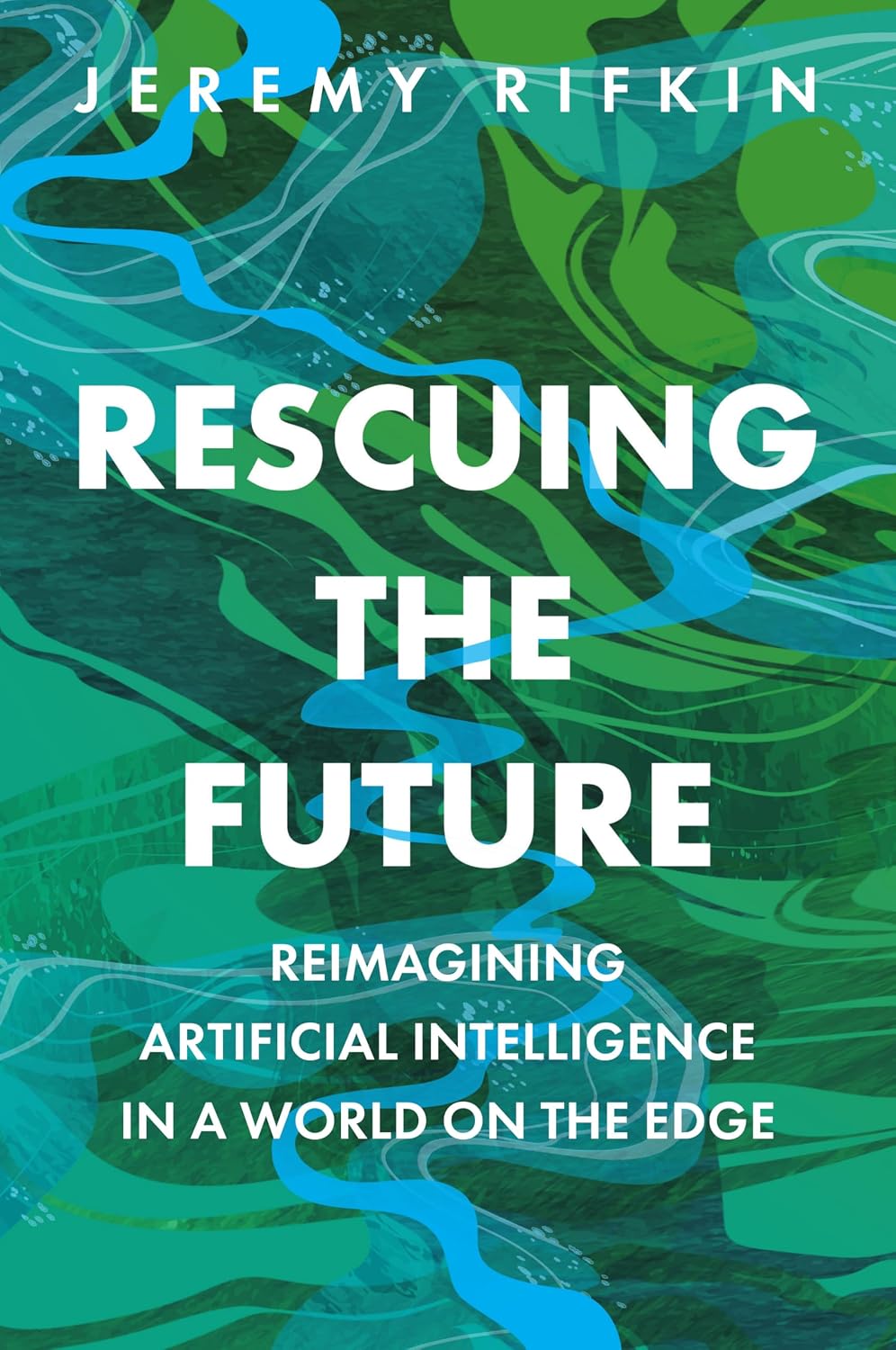
Jeremy Rifkin, one of the World’s Leading Public Intellectuals, Argues in his New Book ‘Rescuing the Future’ that the People’s AI is on a Deep Existential Curve and Likely to Surpass the Corporate AI Giants by 2050 in Bioregions Around the World
Here’s the problem in a nutshell. Climate disasters brought on by global warming don’t respect nation-state boundaries. They affect ecosystems which oftentimes cross both national and regional political boundaries. That so, a spontaneous shift in the notion of governance is occurring wherein nation-states, regions, and municipalities are by necessity crossing political boundaries to prepare, rescue, restore, and steward the common ecosystem in which they dwell. It’s all a matter of survival, resilience, and restoration. Bioregional governance is fast establishing a new layer of political participation that’s more in line with the ecosystem dynamics of the hydrosphere, lithosphere, atmosphere, and biosphere that affect their region.
It’s not that nation-states are going to disappear overnight, but the disquieting reality is that political boundaries everywhere are beginning to bend with the realization that on our Planet Aqua the hydrosphere is the ultimate decider and at this moment in history the prime mover that’s bringing on the floods, droughts, heatwaves, wildfires, hurricanes, and typhoons. The hydrosphere is the indivisible planetary agency that will determine the new political boundaries that have to be stewarded as commons.
Like it or not, the geopolitics of the nation-state era that swept across the planet in the eighteenth, nineteenth, and twentieth centuries is on a death watch, even if not realized or acknowledged. Let’s be honest – the nation-state paradigm of the past several centuries was an imaginary, that is, never an organic politique based on common culture, language, and environmental attachment. Rather, the nation-state is an artificial concept. Still, even now, it’s not uncommon for people to think of the emergence of nation-states as a natural extension of populations that share a common language and culture. For the most part, not so. In 1789 on the eve of the French Revolution, roughly fifty percent of the public spoke French, and only thirteen percent spoke it fluently. In 1861 in Italy, only 2.5 percent of the population used the Italian language for everyday communication. After the unification of Italy as a sovereign nation, Massimo d’Azeglio, a Premier of Piedmont uttered what has become a famous quote: “We have made Italy, now we have to make Italians.”
The point is, nation-states, by and large, were artificial constructs that established a common language and a uniform educational system, accompanied by a cultural mystique that paid homage to past heroes and military feats, many of which did not exist at all or if they did exist, were reimagined to suit the needs of a fledgling nation-state paradigm.
Bioregional governance, however, is organic. The attachment is local and steeped in a rich cultural heritage that leans back for centuries and is always embedded in local ecosystems – often commons – that have nurtured generations of families.
While there’s growing concern that geopolitics is rearing its head once again in the twenty-first century with nations fighting one another in an increasingly dangerous geopolitical environment, in reality what we’re experiencing is the death knell of the geopolitics that accompanied the First and Second Industrial Revolutions of the nineteenth and twentieth centuries embedded in nation-state governance and globalization. A more glocalized and distributed “bioregional governance” is coming of age and just in time – and with it a renewed affiliation with and attachment to local and regional ecosystems.
AI Bioregional governances at-scale are emerging across every continent. And their distributed and regional orientation favors both SMEs and cooperatives. That infrastructure is already in place. While SMEs are ubiquitous, there are also 1.2 billion people working in three million cooperatives across regions on every continent.
Both the First and Second Industrial Revolution infrastructures, powered largely by fossil fuels, regarded nature as raw materials to be extracted and efficiently exploited to advance utilitarian ends exclusively for human beings. To this end, the First and Second Industrial Revolutions of the nineteenth and twentieth centuries were engineered to be centralized and vertically integrated to create economies of scale and required massive financial capital and expansive geopolitical and military commitments to secure their uninterrupted operations.
The Third Industrial Revolution infrastructure is designed to be “distributed” rather than centralized, scales laterally rather than vertically, and is bioregional in impact. This reality is already forcing both local regions and nation-states to cross political boundaries, both internally and externally, and establish formal extensions of governance under the banner of bioregional governance to oversee commonly shared ecosystems, adding a new formal element to governance.
While the current geopolitical endgame is being fought by way of tariff wars to try to hold on to a semblance of nation-state sovereignty, the more subtle withering of nation-state hegemony to accommodate a global workforce is occurring everywhere and is of a far more profound nature – less ideological, and more pragmatic in impact and affecting capitalist and socialist-oriented nation-states alike, both of which are intimately tied to the Age of Progress and globalization. Although these two governing models differ in some fundamental respects with the former championing economic opportunity via the pursuit of self-interest and the latter in pursuit of the collective good, they are both centralized, hierarchically administered, and mired in the substance ontology worldview, perceiving the planet as resources to exploit, bundle, and consume.
In sharp contrast, the new bioregional commons governance is decentralized and democratically administered in the form of stewardship of shared ecosystems that often cross nation-state boundaries. And both capitalist and socialist nation-state governments are encouraging bioregional governance across political and ideological borders in the stewarding of shared ecosystems realizing that their very survival comes with this new departure in history.
As well, the collective attachment to shared bioregional governance across traditional political boundaries favors a smart distributed and decentralized AI infrastructure with distributed edge data centers, distributed AI-driven solar and wind generation, distributed and autonomous electric and hydrogen fuel cell transport, distributed water microgrids, and distributed additive infofacturing of buildings placing stewardship in the hands of local populations that share these ecosystems.

Jeremy Rifkin is the bestselling author of twenty-five books translated into over thirty-five languages. He is a principal architect of the European Union’s and China’s economic plans for transitioning into a Third Industrial Revolution and he served as an economic advisor to Senate Majority Leader Charles Schumer on the U.S. infrastructure plan. He is listed among the top ten most influential economic thinkers in The Huffington Post’s global survey of “The World’s Most Influential Voices.”